Rewriting the Narrative on Menopause at Work
Tatiana Rowson brings together insights from two studies to explore the disconnect between how menopause is portrayed in the press and what women actually experience at work. She shows how unhelpful media framing and rigid ‘ideal worker’ norms are holding women back and what employers can do differently.

A growing issue with economic implications
Midlife women represent a significant and growing share of the UK workforce. This life stage often coincides with menopause, a transition that is estimated to cost the UK economy around £1.5 billion through unemployment and a further £191 million through absenteeism. This is not a niche issue but a business imperative that demands serious attention.
What the media tells us – and what it gets wrong
In my first study, I examined how menopause has been depicted in the UK press. Using a computational method to analyse nearly 3,000 newspaper articles published between 2010 and 2021, the study mapped the language and framing used to describe menopause and work at scale.
From ‘disease’ to ‘disruption’, the language problem
Coverage grew substantially over this period – from just three articles in 2010 to nearly 550 by 2021 – suggesting that public awareness has increased. However, the tone changed very little. In earlier coverage, menopause was predominantly framed through a medical lens, associated with disease, decline and loss. Words like ‘cancer’, ‘depression’ and ‘dementia’ appeared frequently alongside menopause, framing it as a serious illness.
“The framing remains damaging.”
More recently, media attention has shifted to include increased content on menopause and work – but the framing remains damaging. Words like ‘terrify’, ‘warn’, ‘court’ and ‘discrimination’ consistently portray menopausal women as a workplace liability rather than a professional asset. Employers are positioned as under threat of litigation from employees rendered unpredictable by their symptoms. Positive stories of menopausal women thriving at work are almost entirely absent – despite the fact there are many of these stories in real life.
Reframing the story to remove stigma
This matters because the stories we tell shape the culture in which workplace policy is developed. Even well-intentioned coverage can reinforce the idea that women of menopausal age are no longer fully fit to work, perpetuating the stigma around menopause. For organisations to support women effectively, narratives must become more balanced and inclusive.
What women actually experience
My second study took a different approach, bringing together findings from 22 existing research studies to build a picture of what women actually experience during menopause at work – and why.
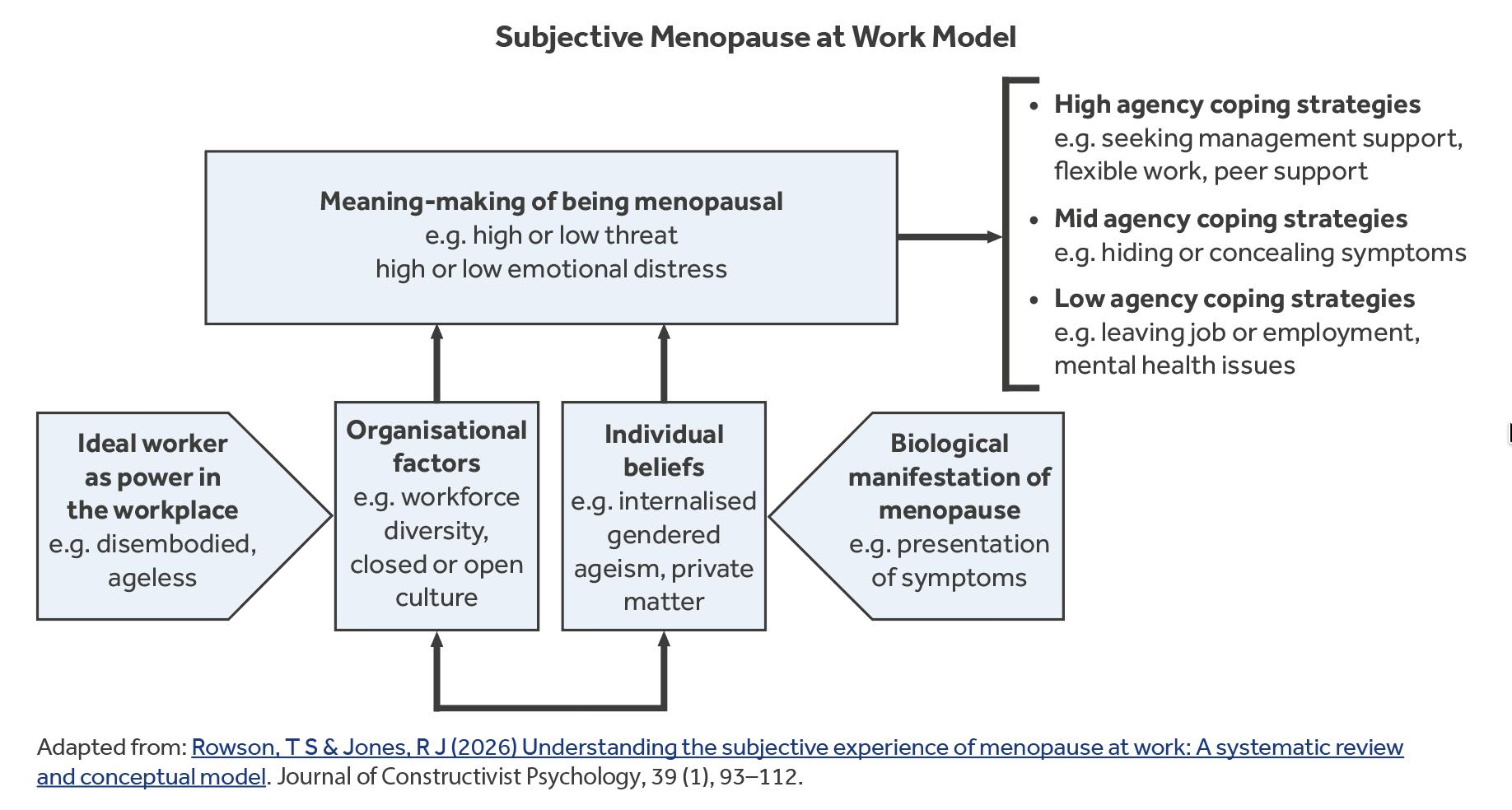
The ‘ideal worker’
The findings show that many workplaces operate around an unspoken ‘ideal worker’ standard – one that is ageless, always available and implicitly male. When menopausal symptoms are visible or difficult to control, women can feel they are falling short of this standard, triggering shame, loss of confidence and withdrawal.
Workplace culture plays a significant role. Environments dominated by masculine norms (e.g. science and technology sectors), unsupportive managers, lack of awareness among colleagues and inadequate physical environments, all make things worse. But the reverse is also true: open cultures, peer support and even small practical adjustments, such as access to a desk fan or flexible working, can make a meaningful difference.
Coping in silence or opting out
Individual beliefs matter too. Women who feel menopause is a private matter are more likely to suffer in silence, which can compound distress and accelerate disengagement from work. Coping strategies depend on how empowered women are and range from actively seeking support and flexible arrangements, to quietly reducing hours or leaving the workforce altogether.
“Coping strategies depend on how empowered women are.”
From this research I developed the Subjective Menopause at Work Model – a practical framework to help organisations understand and address the full picture, not just the physical symptoms.
A real-world impact
My research has reached well beyond academia. For example, I was invited to join the expert review panel for the Department for Work and Pensions’ 2025 report on menopause in the workplace. My work also contributed to the Better Hiring Institute’s Timeless Skills: Embracing Age Diversity at Work guide, following a Modernising Employment All-Party Parliamentary Group meeting in December 2025.
While my focus is menopause, the implications reach further. Understanding how women navigate menopause at work sheds light on how all workers manage ageing transitions and what organisations need to do to retain them. Workplaces that support menopausal women do not just hold on to talent, they send a signal that every worker, at every stage of life, has value.
Author

Dr Tatiana Rowson
Associate Professor in Organisational BehaviourDr Tatiana Rowson is an Associate Professor in Organisational Behaviour at Henley Business School. Her research interests include: ageing at work and the experiences of older workers, exploring how life, work and career transitions from midlife impact on health and wellbeing, labour force participation and economic activity in later working life. She also studies how individuals make sense of, and respond to, changing circumstances at identity and behavioural levels.
